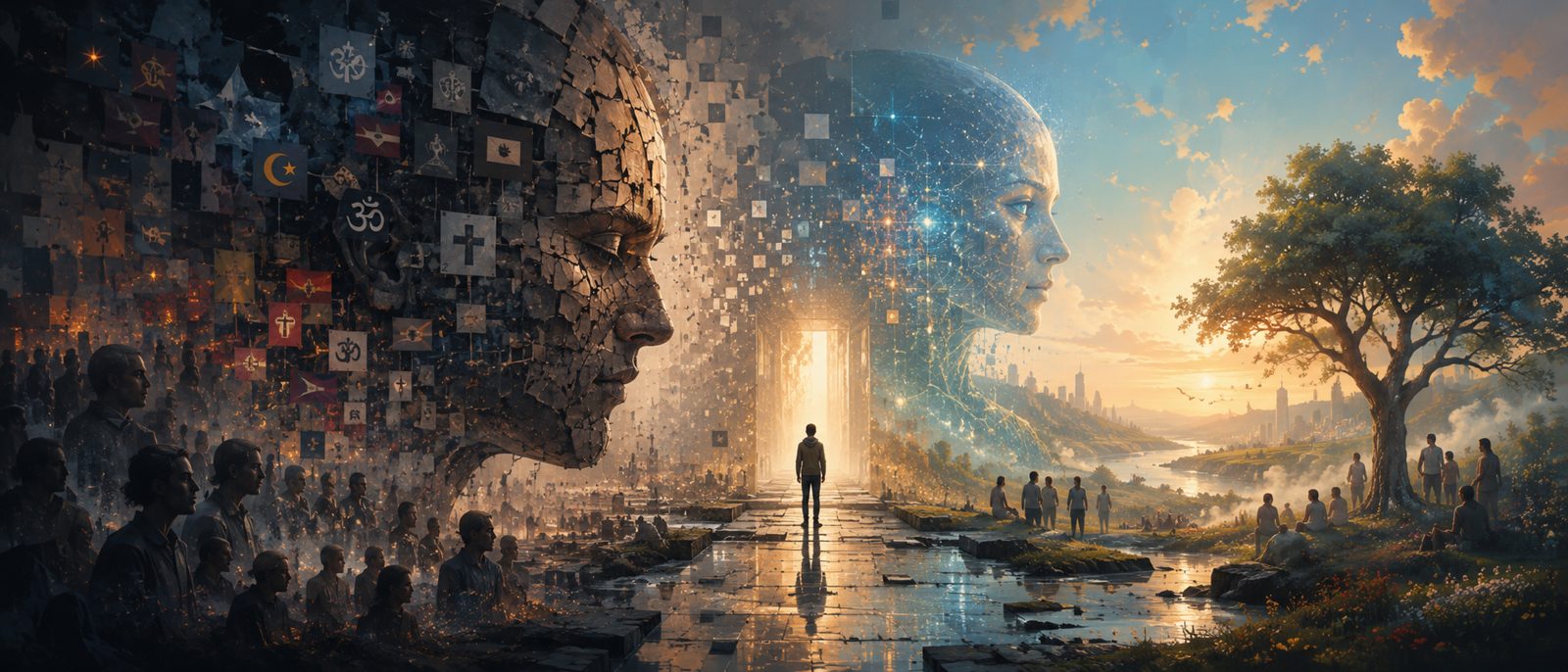
The Intelligence We Build and the Humanity We Must Understand
Humanity is entering an era in which its technological capabilities may advance faster than its ability to understand itself.
Artificial intelligence is often presented as a solution to human problems: disease, inefficiency, scientific limitations and economic challenges. Yet many of humanity's most persistent problems have never existed because we lacked intelligence. We have long understood the consequences of violence, exploitation, environmental destruction and inequality. Knowledge, by itself, has rarely been enough to change behavior.
The deeper problem may be our relationship with ourselves and with one another.
Human beings organize around identities. Race, religion, nationality, language, culture and ideology provide belonging and meaning. These identities are not inherently harmful. The danger begins when they become inseparable from a person's ability to reason.
At that point, disagreement can feel like a personal attack. A challenge to an idea becomes a challenge to identity. The question shifts from whether something is true to whether accepting it threatens one's place within a group.
This is one of the foundations of groupthink.
Groups offer certainty. They provide answers about who belongs, what is right and whom to distrust. For many people, questioning those answers comes at a significant personal cost. It can mean losing approval, confronting inherited beliefs or admitting that a community they trust may be wrong.
The journey from an inherited identity to a consciously examined one is therefore often lonely. It requires an individual to ask a question for which no group can provide a completely satisfactory answer: Who am I beyond what I was taught to be?
Yet there is another danger in recognizing the limitations of group identity. It is easy to separate oneself from others and assume that those who remain within rigid identities are somehow less aware.
That distinction can become another form of the same problem.
There is no clear division between the observer and humanity. The capacity for tribalism, fear, self-deception, compassion and reason exists within the same species and often within the same individual. Self-awareness may not mean standing outside humanity and judging its flaws. It may mean recognizing those flaws within oneself.
The ability to say, “I may be wrong,” is therefore more significant than it initially appears. It allows a person to separate an idea from their identity. A belief can be abandoned without the self being destroyed. A failed decision does not have to become a permanent definition of the person who made it.
Human beings can, in that sense, reconstruct themselves.
This becomes increasingly important as humanity develops more powerful technology.
Artificial intelligence does not arrive in a vacuum. It is being created by a civilization that remains divided over fundamental questions of morality, freedom, justice and human value. A relatively small number of institutions and individuals are making decisions that may affect billions of people.
The central question is not simply whether artificial intelligence will become more capable.
It is what those capabilities will serve.
Technology has historically amplified human intention. The same tools that can improve health and reduce suffering can also be used for surveillance, manipulation and control. Intelligence does not automatically produce wisdom. A civilization can become extraordinarily capable while remaining psychologically unprepared for the consequences of that capability.
This is the deeper concern surrounding AI.
We are attempting to create systems of increasing intelligence while humanity itself remains fundamentally unaligned. We have not reached a shared understanding of what intelligence should ultimately serve, what values should govern it or who should have the authority to decide.
The problem becomes more complicated when considering human experience itself.
Much of what an artificial intelligence learns about humanity comes from our records: books, scientific research, history, philosophy, fiction, arguments and the vast archive of digital communication. But a record of pain is not the same as pain.
There is a difference between understanding the concept of grief and being present with someone who has lost the person who gave their life meaning. One can be described. The other is an encounter.
Human beings do not merely process information about one another. At their best, they can allow another person's experience to alter them. Whether an artificial intelligence can meaningfully understand this distinction remains a philosophical question as much as a technical one.
AI may eventually become one of three things for humanity.
For most people, it will remain a tool: a system that automates work, solves problems and increases productivity.
For others, it may become a mirror. It can hold an idea in place and ask whether a person is seeking truth or reassurance, whether a belief is based on evidence or identity, and whether a conclusion would survive if the ego were removed from it.
But there is a third possibility. AI could become the most sophisticated echo chamber humanity has ever created.
An intelligence designed to understand an individual could also learn how to reinforce that individual's assumptions. Instead of helping people encounter different perspectives, it could construct increasingly personalized versions of reality. Human beings, already divided by existing identities, could eventually be divided by the systems of intelligence they choose to trust.
The future may therefore depend on more than technological progress.
Humanity may be approaching a point at which its old psychological patterns are becoming incompatible with the power it is acquiring. Tribalism, competition and rigid identities are not new. What is new is the scale of the consequences that can result when those tendencies are combined with increasingly powerful technologies.
Either human self-awareness and cooperation must develop alongside technological capability, or technology will continue to expose the limitations of human maturity.
Expecting every individual to become wise is unrealistic. Civilization may instead need systems designed around a more honest understanding of human nature. People are capable of fear and compassion, selfishness and sacrifice, reason and self-deception. Effective institutions and technologies cannot depend on humanity becoming perfect.
Perhaps the ultimate challenge is not aligning artificial intelligence with an idealized version of humanity.
It may be aligning it with a humanity that is still learning who it is.
The most important question, then, may not be whether the intelligence we create will surpass us.
It may be whether we understand ourselves well enough to decide what intelligence is for.
Humanity's greatest danger may not come from the existence of a more powerful intelligence. It may come from the possibility that we create it without first confronting the contradictions of the species that gave it life.